Nuxlera
Mode Capsule
Mode Capsule
Couldn't load pickup availability
Self-paced learning overview
- 📥 Digital file available after purchase
- ♾️ Long-term availability
- 🔒 Secure checkout
- 📅 Content updated in 2026
1. Problem Statement
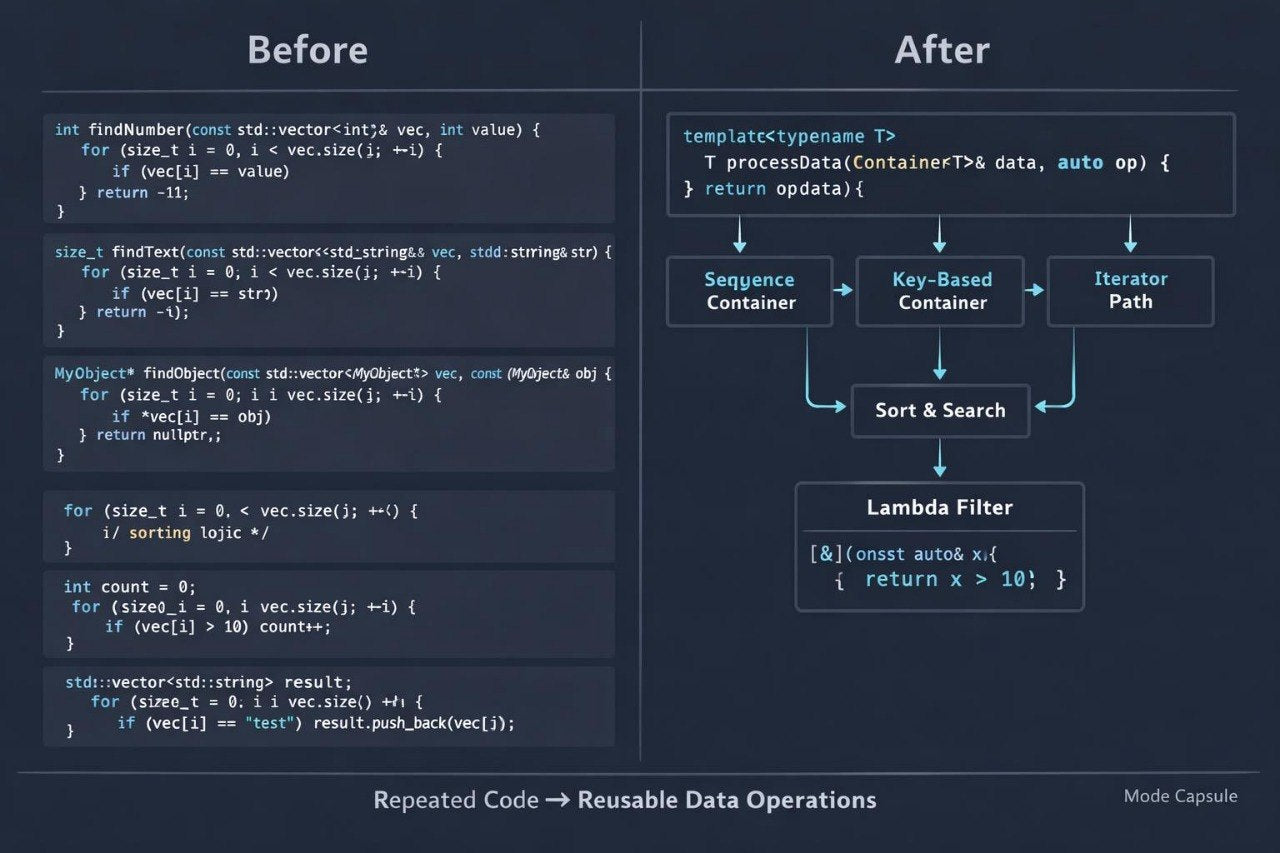
Struggling to maintain code when the same operation is repeated for numbers, text, and custom types? You’re not alone: separate functions for every type gradually increase the program size and the number of areas requiring revision. Building every storage structure manually can also distract from the central task logic. Without knowledge of containers, iterators, and existing algorithms, data processing may rely on many similar loops. Mode Capsule explains how to create generic components and select suitable tools for different collections.
2. Solution
This course will teach you how to create function and class templates that work with several data types. You will study containers for sequential, ordered, and key-based storage. Separate modules demonstrate how iterators move through collections and how algorithms perform searching, sorting, counting, and transformation tasks. Lambda expressions provide local processing rules without requiring numerous separate functions. In the concluding task, you will build a record-processing system using generic components and several container types.
3. What’s Inside
Module 1: Generic Programming Principles
Separate shared logic from a particular data type and identify the operations required by a reusable component.
Module 2: Function Templates
Create functions for comparison, searching, exchange, and calculations that work with several compatible types.
Module 3: Class Templates
Build template classes for storing and processing values, then create objects using different type parameters.
Module 4: Sequential Containers
Study ordered storage, element insertion, removal, and movement through a collection.
Module 5: Associative Containers
Store records by key, locate selected entries, and check whether a required element exists.
Module 6: Iterators and Ranges
Mark the beginning and end of a range, move through its elements, and provide ranges to algorithms.
Module 7: Search and Sorting Algorithms
Apply existing operations for searching, sorting, counting, checking, and rearranging elements.
Module 8: Lambda Expressions
Write compact local rules for comparison, filtering, and data modification.
Module 9: Custom Types in Containers
Prepare custom classes for storage, sorting, and searching inside collections.
Module 10: Reusable Component Review
Convert repeated functions into template components and compare several structural approaches.
Module 11: Concluding Course Task
Create a program that stores, filters, sorts, and analyzes records using templates, containers, and algorithms.
4. Who Is This For?
✅ This tier may suit you if you:
- work with classes and dynamic data;
- understand references, pointers, and object lifetime;
- want to reduce repeated functions;
- plan to process larger collections of values;
- are prepared to examine algorithm requirements for data types.
❌ This tier may not suit you if you:
- have not yet worked with functions and classes;
- are unfamiliar with object collections;
- require only foundational syntax;
- do not plan to complete independent practice;
- require individual live instruction.
5. What You’ll Learn
After completing the materials, you should be able to:
- create at least three function templates;
- build a template class for storing values;
- select a container according to data search and modification needs;
- move through a collection with iterators;
- apply sorting, searching, and counting algorithms;
- write a lambda expression containing parameters;
- filter a collection using a defined condition;
- store custom types in several containers;
- replace repeated loops with existing algorithms;
- build a generic record-processing system.
6. Refund Terms
Mode Capsule provides 30 calendar days for submitting a refund request under the policy published by the Nuxlera store. Learners should review the request procedure, evaluation conditions, and stated exceptions before ordering. This process concerns course payment and does not define identical educational outcomes for every learner.
7. Certificate
A Nuxlera certificate may be issued after the required modules and concluding task have been completed. The document records completion of the Mode Capsule materials.
1. Do I need previous C++ experience?
1. Do I need previous C++ experience?
The required background depends on the selected tier. Introductory materials explain foundational concepts, while later tiers gradually cover larger program structures, memory handling, object-oriented principles, and more detailed programming tasks.
2. How are the courses structured?
2. How are the courses structured?
Each course contains ordered modules, written explanations, code examples, practical exercises, and a concluding task. Learners can study at their own pace and return to earlier topics whenever additional review is useful.
3. Can I begin with one tier and continue with another?
3. Can I begin with one tier and continue with another?
Yes. Nuxlera tiers are arranged in an increasing sequence of topics and practical activities. Learners can begin with a tier that matches their current knowledge and continue with another collection when they are ready to study broader material.
4. Is a certificate included?
4. Is a certificate included?
Yes, each tier includes a course completion certificate. It is issued after the learner completes the required modules and submits the assigned concluding activities.
Share