Nuxlera
Edge Capsule
Edge Capsule
Couldn't load pickup availability
Self-paced learning overview
- 📥 Digital file available after purchase
- ♾️ Long-term availability
- 🔒 Secure checkout
- 📅 Content updated in 2026
1. Problem Statement
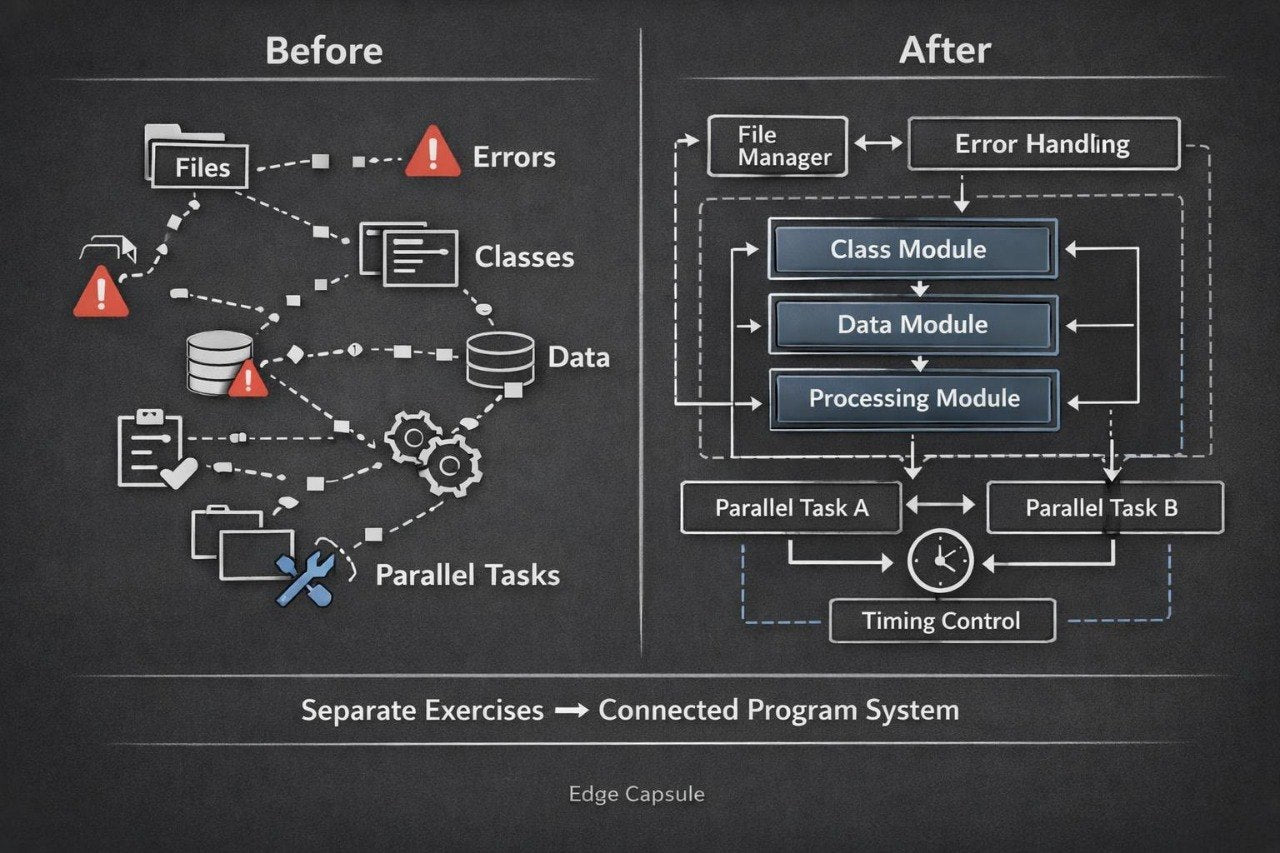
Struggling to move from separate exercises to a program containing many connected components? You’re not alone: larger projects require simultaneous control of data, resources, errors, file operations, and task execution order. Even correctly written classes may create difficulties when their boundaries are not clearly defined. An issue within one component can affect other parts of the program and make the original cause harder to identify. Edge Capsule presents program construction as a sequence of separate decisions, checks, and interactions.
2. Solution
This course will teach you how to combine classes, templates, collections, and resource management within larger program structures. You will study methods for handling exceptional situations and passing error information between components. Separate modules cover file reading and writing, parallel task execution, shared-data synchronization, and measurement of operation duration. Practice tasks guide you through revising code structure, reducing repeated logic, and dividing responsibilities between modules. The concluding project involves building a complete program with several connected parts.
3. What’s Inside
Module 1: Program Architecture Review
Study how a larger task can be divided into models, services, supporting components, and separate operations.
Module 2: Error Handling with Exceptions
Create, pass, and handle exceptions while deciding which program component should respond to each error.
Module 3: Custom Error Types
Define separate error types for different situations and transfer clear information between program components.
Module 4: Reading and Writing Files
Store text and structured data, read existing records, and check the validity of received information.
Module 5: Data Serialization Principles
Convert object state into a form suitable for storage and restore that state during a later program run.
Module 6: Parallel Task Foundations
Start several tasks, wait for their completion, and divide work between separate execution threads.
Module 7: Shared Data and Synchronization
Identify data used by several tasks and apply mechanisms for coordinated value updates.
Module 8: Timing and Performance Review
Measure the duration of selected operations, compare several implementations, and locate code sections performing unnecessary work.
Module 9: Refactoring Larger Programs
Divide long functions, move repeated logic into shared components, and clarify the responsibilities of individual classes.
Module 10: Testing Program Components
Create checks for functions and classes, compare expected and actual results, and process boundary values.
Module 11: Integration Practice
Combine file handling, classes, templates, collections, error processing, and parallel tasks within one structured exercise.
Module 12: Concluding Course Project
Build a program that stores, processes, and analyzes records through several modules, data checks, and a documented structure.
4. Who Is This For?
✅ This tier may suit you if you:
- work with classes, templates, and containers;
- understand resource management and object lifetime;
- want to create programs containing several modules;
- plan to work with files and broader data flows;
- are prepared to analyze code structure and execution time;
- want to combine earlier knowledge within one project.
❌ This tier may not suit you if you:
- are beginning with foundational C++ syntax;
- have not yet worked with classes and templates;
- are unfamiliar with references and memory management;
- require only short introductory exercises;
- do not plan to complete a larger concluding project.
5. What You’ll Learn
After completing the materials, you should be able to:
- divide a program into several logical components;
- create and process a custom error type;
- read information from a file and store an updated result;
- save the state of several objects for later restoration;
- start at least two parallel tasks;
- coordinate work involving shared data;
- measure the duration of a selected operation;
- compare two implementations of one algorithm;
- create checks for classes and functions;
- process empty, invalid, and boundary values;
- restructure a long function into several smaller parts;
- build a complete program using files, collections, classes, and error handling.
6. Refund Terms
Edge Capsule provides 30 calendar days during which a refund request may be submitted under the policy published by the Nuxlera store. Learners should review the request procedure, evaluation criteria, and listed exceptions before placing an order. This condition concerns course payment and does not define the same educational outcome for every learner.
7. Certificate
A Nuxlera certificate may be issued after the required modules and concluding project have been completed. The document records completion of the Edge Capsule materials.
1. Do I need previous C++ experience?
1. Do I need previous C++ experience?
The required background depends on the selected tier. Introductory materials explain foundational concepts, while later tiers gradually cover larger program structures, memory handling, object-oriented principles, and more detailed programming tasks.
2. How are the courses structured?
2. How are the courses structured?
Each course contains ordered modules, written explanations, code examples, practical exercises, and a concluding task. Learners can study at their own pace and return to earlier topics whenever additional review is useful.
3. Can I begin with one tier and continue with another?
3. Can I begin with one tier and continue with another?
Yes. Nuxlera tiers are arranged in an increasing sequence of topics and practical activities. Learners can begin with a tier that matches their current knowledge and continue with another collection when they are ready to study broader material.
4. Is a certificate included?
4. Is a certificate included?
Yes, each tier includes a course completion certificate. It is issued after the learner completes the required modules and submits the assigned concluding activities.
Share