Nuxlera
Echo Capsule
Echo Capsule
Couldn't load pickup availability
Self-paced learning overview
- 📥 Digital file available after purchase
- ♾️ Long-term availability
- 🔒 Secure checkout
- 📅 Content updated in 2026
1. Problem Statement
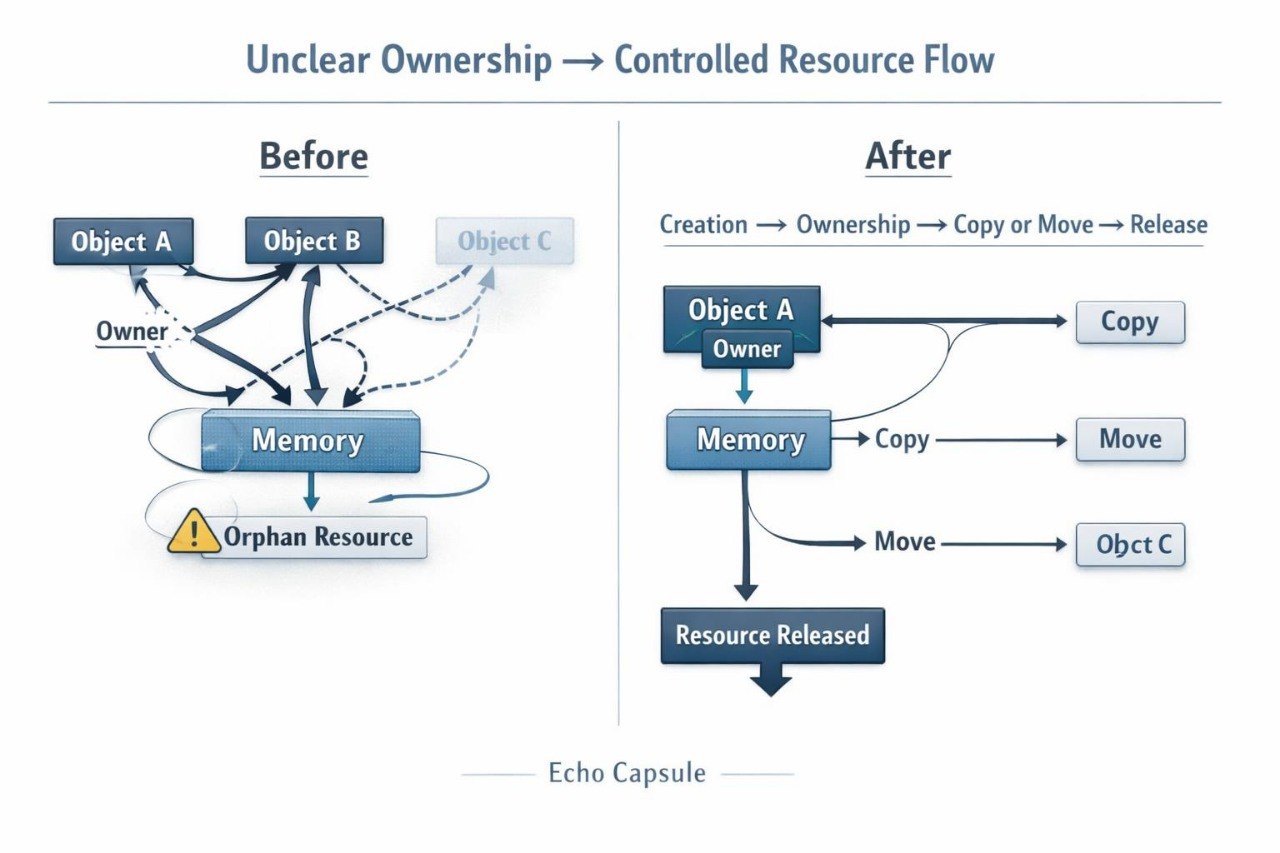
Struggling to track who owns data and when a resource should be released? You’re not alone: programs containing dynamically created objects may include unclear relationships between addresses, resources, and their owners. Incorrect copying can produce several objects referring to the same memory area. This may lead to resource leaks, repeated release operations, or references to data that no longer exists. Echo Capsule explains how object lifetime can be connected to controlled resource management.
2. Solution
This course will teach you how to examine the creation, copying, moving, and destruction of objects. You will study dynamic memory and the rules used to identify a resource owner. Separate modules cover copy constructors, assignment operators, move operations, and automatic memory-management techniques. Practice activities help you identify lifetime errors and revise classes that manage resources manually. The concluding task combines custom classes, dynamic data, and defined ownership rules.
3. What’s Inside
Module 1: Dynamic Memory Foundations
Study how data is created during program execution, handled through addresses, and released after it is no longer required.
Module 2: Object Lifetime
Examine when an object is created, how long it remains active, and when its destructor is called.
Module 3: Resource Ownership
Identify which object is responsible for a resource and describe how ownership is passed between program components.
Module 4: Copy Constructors
Compare shallow and deep copying and create a class that stores an independent copy of dynamic data.
Module 5: Copy Assignment
Study assignment between existing objects, self-assignment checks, and replacement of a previously held resource.
Module 6: Move Operations
Transfer a resource without copying all of its data and examine the valid state of an object after the transfer.
Module 7: Automatic Resource Management
Connect a resource to object lifetime and reduce the number of manual release operations.
Module 8: Managed Pointer Types
Compare several ownership models, including single ownership, shared ownership, and non-owning references.
Module 9: Finding Lifetime Errors
Review examples containing leaks, invalid addresses, repeated release operations, and incorrect destruction order.
Module 10: Revising a Resource Class
Restructure a class that manually manages memory and add defined copying and moving behavior.
Module 11: Concluding Course Task
Build a program containing several classes, dynamic collections, and documented resource-ownership rules.
4. Who Is This For?
✅ This tier may suit you if you:
- understand classes, constructors, and destructors;
- have worked with references and pointers;
- are familiar with inheritance and composition;
- want to examine object lifetime in greater detail;
- are prepared to analyze memory-management errors;
- want to create classes containing dynamic data.
❌ This tier may not suit you if you:
- have not yet created custom classes;
- are unfamiliar with memory addresses;
- require introductory exercises on variables and conditions;
- do not plan to work with dynamic resources;
- require individual live instruction.
5. What You’ll Learn
After completing the materials, you should be able to:
- describe the lifetime of local and dynamic objects;
- create and release a dynamic resource;
- identify the owner of data within a program structure;
- write a copy constructor for a custom class;
- implement a copy-assignment operator;
- add a move constructor and move-assignment operator;
- distinguish shallow copying from deep copying;
- work with managed pointer types;
- identify at least four common lifetime errors;
- revise a class that manages resources manually;
- create a program with defined data-ownership rules.
6. Refund Terms
Echo Capsule provides 30 calendar days during which a refund request may be submitted according to the policy published by the Nuxlera store. Learners should review the request procedure, evaluation criteria, and listed exceptions before ordering. This condition concerns course payment and does not state that every learner will achieve the same educational outcome.
7. Certificate
A Nuxlera certificate may be issued after the required modules and concluding task have been completed. The document records completion of the Echo Capsule materials.
1. Do I need previous C++ experience?
1. Do I need previous C++ experience?
The required background depends on the selected tier. Introductory materials explain foundational concepts, while later tiers gradually cover larger program structures, memory handling, object-oriented principles, and more detailed programming tasks.
2. How are the courses structured?
2. How are the courses structured?
Each course contains ordered modules, written explanations, code examples, practical exercises, and a concluding task. Learners can study at their own pace and return to earlier topics whenever additional review is useful.
3. Can I begin with one tier and continue with another?
3. Can I begin with one tier and continue with another?
Yes. Nuxlera tiers are arranged in an increasing sequence of topics and practical activities. Learners can begin with a tier that matches their current knowledge and continue with another collection when they are ready to study broader material.
4. Is a certificate included?
4. Is a certificate included?
Yes, each tier includes a course completion certificate. It is issued after the learner completes the required modules and submits the assigned concluding activities.
Share